Pruzin JJ, Yau WW, Bress AP, Bardaran H, Chhatwal JP, Tariot PN, Cushman WC, Gupta A, Wright CB, Williamson J, Reboussin DM, Pajewski NM, Nasrallah IM, Kern KC. Effect of Intensive Systolic Blood Pressure Control on Markers of Cerebral Small Vessel Disease by Age. Hypertension. 2025 Dec;82(12):2150-2161. doi: 10.1161/HYPERTENSIONAHA.125.25202. Epub 2025 Oct 29. PMID: 41159258.
We previously looked at a study exploring the association between hypertension and dementia, in which socioeconomic status was a major unacknowledged confounding factor. We have also discussed a number of studies where the biochemical mechanisms associated with hypertension and the drugs that interact with them have been ignored in favor of an overly simplistic relationship between systolic blood pressure and outcomes.
In this post-hoc analysis of the SPRINT and ACCORD trials, which was recently published in the journal Hypertension, these concepts intersect, potentially resulting in a misunderstanding of the relationship between hypertension and dementia.
In these studies, subsets of patients underwent baseline and follow-up brain MRI imaging, and were evaluated for measures of degenerative disease. In the ACCORD trial only, there was an interaction with age-group and intensive blood pressure control, indicating a reduction in progression of WMHv (White Matter Hyperintensity Volume) in younger patients (<= 65), as compared with older patients. Additionally, the authors report broader trends suggestive of slower progression in both trials, bolstering the case that intensive blood pressure control slows brain atrophy, particularly at younger ages.
Even if these trends are taken at face value, statistically significant or not there is a major factor confounding the relationship between hypertension and cerebral small vessel disease: the hormones angiotensin and aldosterone.
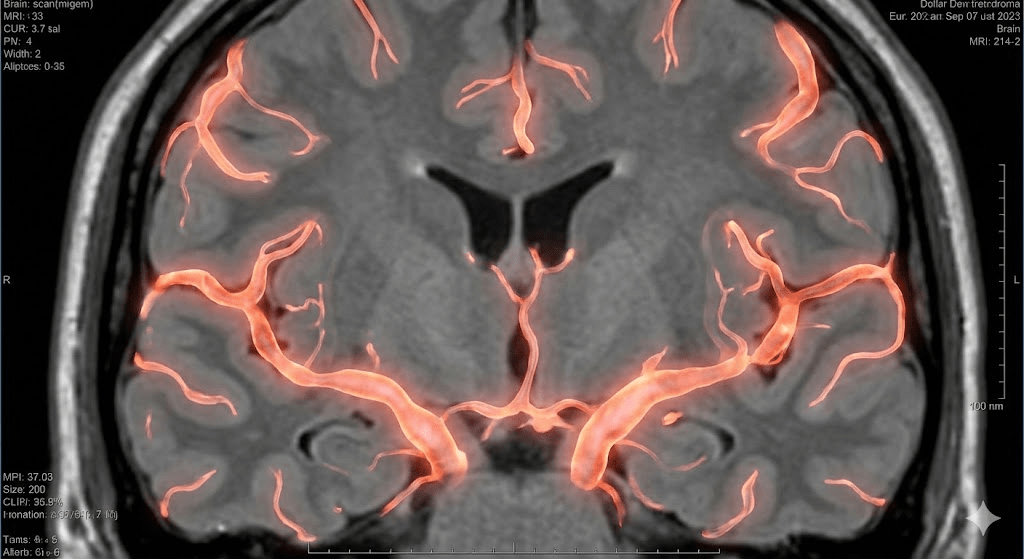
While both are implicated in resistant hypertension and are targets of treatment, they also independently cause neuronal oxidative stress and inflammation (https://pmc.ncbi.nlm.nih.gov/articles/PMC7349348), which have been shown to be associated with white matter disease, and blood pressure drugs affecting this axis such as ACE inhibitors and angiotensin receptor blockers (ARBs) have been shown to be protective (https://www.frontiersin.org/journals/aging-neuroscience/articles/10.3389/fnagi.2023.1137197/full).
Patients subjected to intensive blood pressure control would likely receive more and higher doses of these drugs, explaining the better neuroprotection independent of blood pressure itself. This could also explain the stronger results in the ACCORD trial as compared with SPRINT, since these drugs would be indicated in particular for diabetic kidney disease.
But if intensive blood pressure control achieves this result, why does it matter if the underlying cause is a systolic blood pressure under 120 mmHg or another effect of an ACE inhibitor? The answer is that if intensive control if achieved without these specific drugs, there may be no benefit, or if the patient does not reach the target blood pressure with maximum tolerated doses of these drugs, additional drugs from different classes may be added to further control blood pressure without any added benefit in terms of preventing cerebral small vessel disease and dementia.
In this paper, Dr. Confounder found no consideration of the possibility that the choice of drug might actually matter. Across the spectrum of clinical hypertension research, this needs to change.


 Dr. Confounder
Leave a comment